DPG Physics School 2009
supported by the Wilhelm and Else Heraeus - Foundation
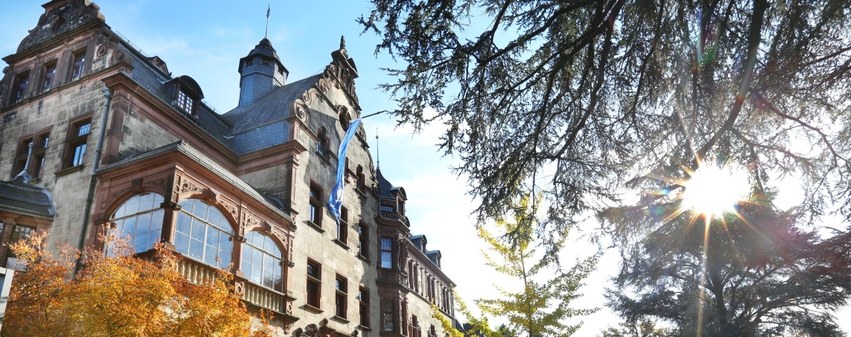
6 - 11 September 2009, Physikzentrum Bad Honnef, Germany
Biointerfaces
Joachim P. Spatz+*, Michael Grunze* & Tamas Haraszti+*
+ Max Planck Institute for Metals Research Stuttgart
* University of Heidelberg
Biointerfaces are of immense interest in physics, chemistry, material sciences, biology and many industrial relevant
applications. For example, the interaction of stem cells with surfaces has a great significance in determining their
fate such as differentiation into various cell lineages or determining cell death. Bacteria at interfaces are of
enormous industrial relevance, yet the development of "optimal" surfaces for avoiding bacteria colonization has to
undergo discoveries in basic research. Migration of parasites through tissue is strongly determined by their interaction
with its environment.
In general, the interaction of the biological matter with interfaces highly depends on the physical chemical nature of
the applied surfaces. In recent years, our knowledge on various factors influencing the protein, bacteria and cell adhesion
increased to the point, that it became possible designing surfaces with various adhesion or even signaling behavior -
inducing adhesion or even apoptosis- towards the cells. Understanding and gaining control over such properties requires
an interdisciplinary approach spreading through various fields of physics, chemistry and biology. During this school, we
provide a most up-to-date view into the field, discussing topics, such as cells and proteins at interfaces (adhesive and
repelling), applied surface technologies, preparation and synthesis of the surfaces and theoretical approaches in
understanding these phenomena. We expect participants with a strong interest in interdisciplinary research at the master's,
doctoral, post-doctoral level and beyond to strongly benefit from the school.
Lecturers
-
Alex de Beer, Max-Planck Institute for Metals Research
I: Principles of IR spectrocopy, elipsometry, Raman spectroscopy and Sum Frequency Generation
II: Principles of light scattering, and nonlinear light scattering
-
Michael Börsch, U Stuttgart
Monitoring the two rotary motors of a single FoF1-ATP synthase by FRET
-
Dieter Braun, LMU Munich
I: Microthermal basics
II: Life driven by thermal forces?
-
Ana Gracia-Saez,Biotechnology Center TU Dresden
I: Introduction to FCS. Approaches to study membranes
II: Apoptosis regulation by Bcl-2 proteins at membranes
-
Fredrik Höök, Chalmers Universitu of Technology
From macroscopic to nanoscopic sensing of supported lipid bilayers and tethered lipid vesicles
-
Martin Loose, Biotechnology Center TU Dresden
How molecules make waves - Self-organisation of Min proteins in Vitro.
-
Sylvie Roke, Max-Planck Institute for Metals Research
I: Recent developments in nonlinear surface spectroscopy
II: Nonlinear light scattering from soft matter and biomedical particles and droplets
-
Andreas Volkmer, U Stuttgart
Coherent Raman scattering microscopy: Labelfree and quantitative chemical analysis of living cells and tissue
-
Jörg Wrachtrup, U Stuttgart
Imaging with nm resolution and chemical specificity: the beauty of spins
« back
|
|